Election 2027: the planning starts now
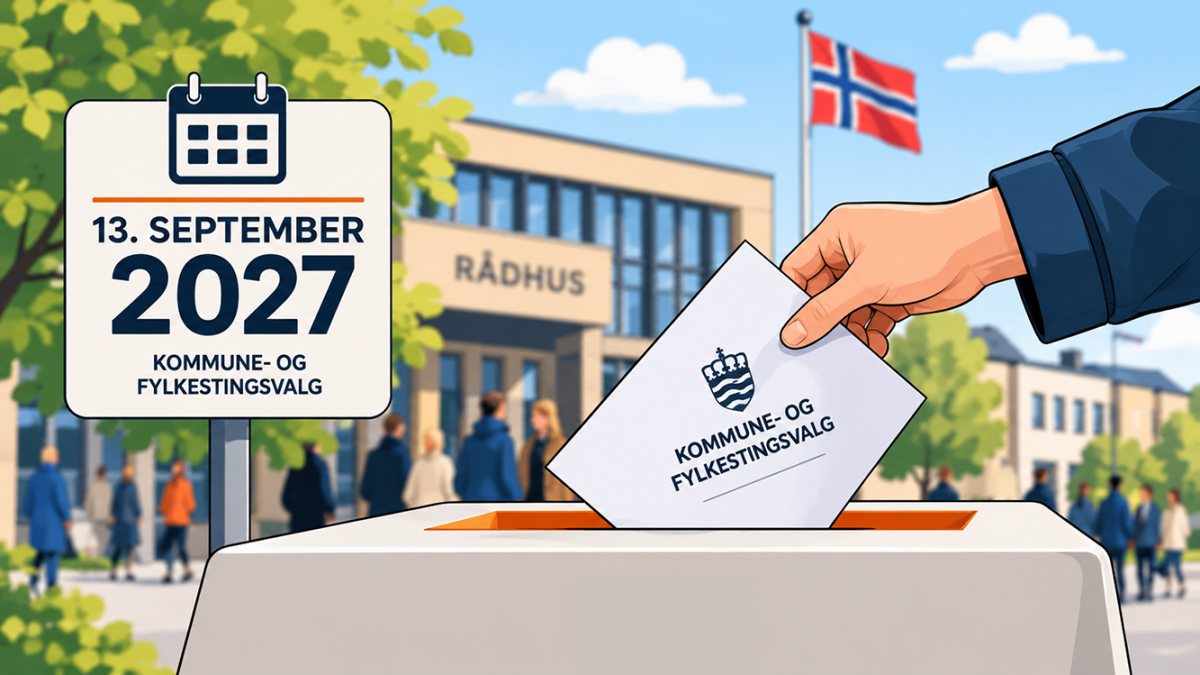
On 13 September 2027, Norway goes to the polls again, this time for the municipal and county elections.
The campaign has not started yet, but the planning has. This is when party programmes are written, candidates are nominated and voters start to link parties with the issues they care about.
Unsure what the new EU rules on political advertising mean for you? You’ll find an overview of what applies in Norway at the end of this article. Kobler is ready, whatever happens.
Key dates for the 2027 election
1 July: early voting opens
10 August: ordinary advance voting begins
10 September: last day of ordinary advance voting
13 September: election day
(Some municipalities also open on Sunday 12 September)
What we learned from the 2025 election
Many of the political parties used Kobler in the 2025 general election, and it taught us a lot. One of the clearest trends we saw was that voters do not all decide on election day. Voters make their decisions at different points throughout the campaign.
In the 2025 general election, more than 60 per cent of voters voted before election day, and advance voting has grown steadily over the past decade. In the 2023 local elections, the figure was almost half. In the Kobler platform, we also saw that reading on political topics was well above normal levels as early as January to March.
This means the media budget should be spread differently than before. Reach voters early, and show them which causes you fight for and what you want to change. By the final weeks, many voters will already have made up their minds, so make sure your party is on their list before then.
“During the campaign, we chose to move much of our advertising budget away from Facebook and over to Kobler. I think more parties can safely let go of the idea that you have to reluctantly pour money into Facebook to succeed.”
Four phases, two peaks
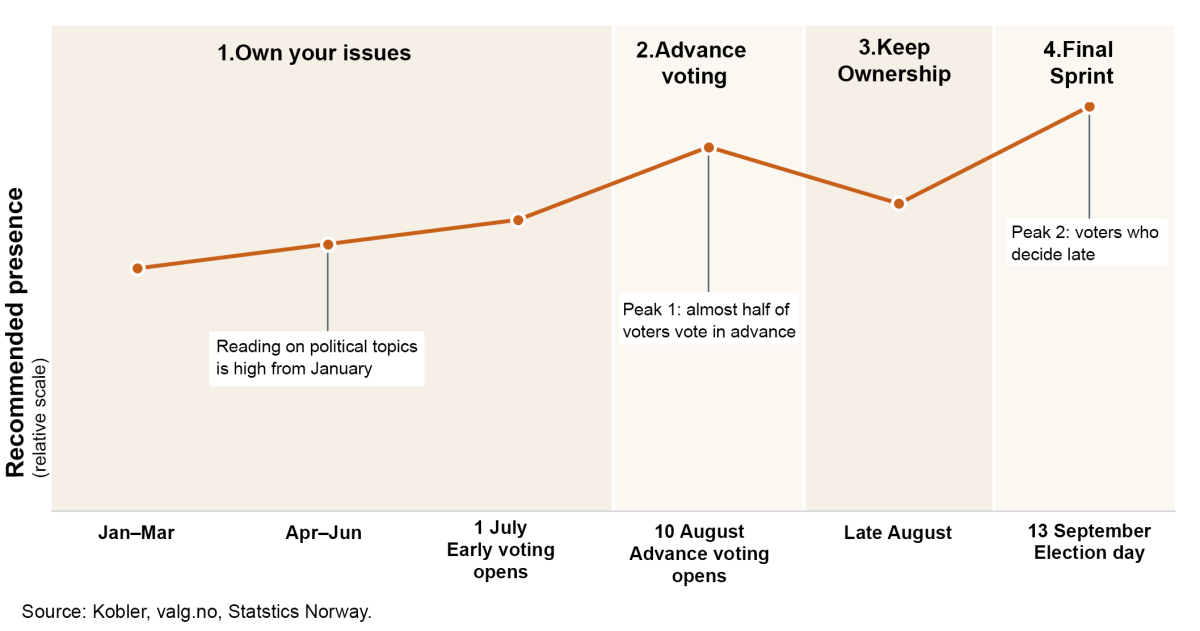
An election campaign has four phases:
Own your issues (January–July): This is when voters decide which party they associate with which issues. In 2025, 4 in 10 voters chose a different party than last time, so be on their list from the start. Early voting opens as soon as 1 July.
Advance voting opens (August): In the last local elections, almost half of voters voted before election day. By this point, voters should be in no doubt about who is fighting for the issues they care about.
Keep ownership (August–September): Stay visible on your issues, so no one else takes them.
Final sprint: This is when you reach the voters who decide at the last minute.
The two peaks come in August and September. But it is the work parties put in from January that decides who voters think of when they cast their vote.
You can read more about what we learned last year in Political marketing: what we learned from the 2025 election.
In a local election, almost everything is political
In a general election, much of the debate is about the big national issues. In a local election, everyday life decides: the children’s school, the road you drive to work every day, property tax and the waiting time to see your GP.
Voters don’t read about “politics”. They read about issues that affect them directly, and they do so all year round. That gives you many more chances to be present in the issues voters care about most.
| Key issue | Examples of relevant keywords |
|---|---|
| Elderly care | sykehjem, hjemmetjeneste, eldrebolig, omsorgstjenester, velferdsteknologi, demensomsorg, pårørende, seniorsenter |
| Schools | skolestruktur, skolenedleggelse, lærertetthet, skolemiljø, skolevei, SFO, skolebygg, rektor |
| Transport | kollektivtilbud, bussrute, bompenger, veivedlikehold, gang- og sykkelvei, trafikksikkerhet, brøyting, fergesamband |
| Health | legevakt, fastlege, ventetid, helsestasjon, psykisk helse, rusomsorg, jordmor, kommunehelse |
| Housing and local economy | eiendomsskatt, kommunale avgifter, boligbygging, tomteregulering, førstegangskjøper, utleiebolig, kommunebudsjett, boligpriser |
This list of keywords is only a starting point. The keywords are in Norwegian because they are matched to articles on Norwegian news sites. In the platform, you can easily add the keywords that match the issues in your municipality.
Be present where your key issues are discussed
Kobler is a contextual advertising platform with more than 330 editorial news sites across the Nordics. With Kobler, you choose:
which media you want to advertise in
which articles your ads should be linked to
your own keywords for the issues that matter most to you
A local branch campaigning for shorter queues at the out-of-hours clinic could, for example, use keywords such as legevakt, ventetid and fastlege. A party focused on better public transport could choose buss, bybane and bompenger. Your ads then appear in the articles about exactly that, from the day the story is published.
That is why it pays to have your campaigns ready early. Once they are set up, you are present the moment a new story about your issue appears. You can see which articles your ads appear next to, and how reading patterns develop through the year, so you can adjust along the way in step with what voters care about.
And we use no personal data. Your ads appear where voters read about your issues, without anyone following them around the internet.
The rules you should know
In the EU, political advertising has been regulated since October 2025 by the Regulation on the Transparency and Targeting of Political Advertising (TTPA), and Meta and Google chose to stop political ads there. The situation in Norway is different.
TTPA is not yet part of the European Economic Area (EEA) Agreement or Norwegian law. The government aims to send out a consultation paper on implementing it during the winter of 2026/2027, and there are several steps left before TTPA may apply in Norway. Given the delays in bringing the Digital Services Act (DSA) into Norwegian law, it is reasonable to expect that TTPA may also be delayed, possibly until after Norway’s local elections in September 2027.
Whatever happens, Kobler has you covered. Our solution already supports TTPA and was used by Swedish publishers during Sweden’s 2026 election. Ads are automatically labelled, transparency information is handled, and we take care of the technical integration and coordination with publishers, so you can focus on your advertising campaigns.
Regardless of TTPA, we quality-check your campaigns and creatives every day to help ensure that your advertising complies with all applicable rules and requirements.
Have you started planning?
The planning starts now. Get in touch, and we will look at how you can be present in the issues voters read about, throughout the election year.
Contextual political advertising places ads alongside editorial content related to the issues a party wants to highlight. Instead of using personal data or individual profiles, the ads are matched to the topic of the article.
The municipal and county elections take place on Monday 13 September 2027. Some municipalities also open for voting on Sunday 12 September.
Early voting opens on 1 July 2027. Ordinary advance voting runs from 10 August to 10 September 2027.
Reading on political topics is high from January, and early voting opens on 1 July. Parties that are visible on their key issues before the summer are already known when voters start to vote.
Not yet. TTPA is not part of the EEA Agreement or Norwegian law, and it may not apply until after the local elections in September 2027. Kobler’s solution already supports TTPA, so you are ready whatever happens.
Yes. With Kobler's contextual advertising platform, ads are shown next to articles about your issues. The ad is matched to the content of the page, not to who the reader is.
Be present
in your
key issues
Planning your political ads for the 2027 election? Contact one of our advisers.

- Sales Manager
- eirik@kobler.no
- +47 414 60 561

- Nordic Key Account Manager
- josefine@kobler.no
- +47 934 56 430
